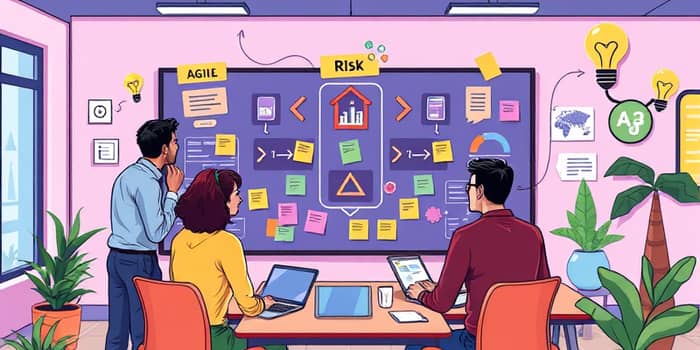
In today’s business landscape, change is the only constant. Companies face shifting market demands, technological disruption, and unpredictable global events. To survive and thrive, organizations must go beyond traditional planning. Agile Risk Management offers a flexible, iterative approach that embeds risk handling into every sprint and daily stand-up. Rather than relying on static plans, teams continuously identify, assess, mitigate, and monitor threats in real time.
As the famous military strategist Helmuth von Moltke said, “No plan survives contact with the enemy.” In volatile contexts, having multiple adaptive plans and the ability to pivot quickly becomes a competitive advantage. This article explores core principles, benefits, practices, and real-world evidence for adopting agile risk management in rapidly changing environments.
Understanding Core Principles of Agile Risk Management
At its heart, Agile Risk Management prioritizes team collaboration, empirical learning, and responsiveness over rigid procedures. It aligns with methodologies like Scrum by embedding risk awareness into every event:
• Daily stand-ups become risk-flagging sessions. • Sprint planning surfaces uncertainties in backlog items. • Retrospectives focus on recurring threats and process improvement.
By shifting from periodic risk reviews to continuous assessment, organizations gain the agility to detect and address issues before they escalate. Short feedback loops ensure that emerging threats are surfaced, discussed, and mitigated within days, not months.
Key Benefits in Dynamic Landscapes
In environments such as digital transformation programs or markets driven by rapid tech innovation, agile risk management delivers tangible advantages:
- Adaptability and Resilience: Anticipate disruptions early and implement timely mitigations to reduce crisis impact on reputation, finances, and operations.
- Improved Decision-Making: Leverage real-time data to weigh options, allocate resources, and capitalize on emerging opportunities.
- Empowered Teams: Decentralized decision making shortens response times and fosters ownership at all levels.
- Transparent Communication: Stakeholders gain confidence through clear, continuous risk reporting and collaboration.
Traditional Versus Agile: A Comparative Perspective
Understanding the contrast between static and adaptive approaches illuminates why agile methods are increasingly favored:
Embedding Risk Management in Agile Practices
To weave risk handling into the fabric of agile, teams incorporate dedicated risk checkpoints into core events. For example:
- Sprint Planning: Identify backlog items with high uncertainty; plan spike tasks or research to mitigate unknowns.
- Daily Scrum: Flag blockers and emerging threats; assign immediate action owners.
- Sprint Review: Gather stakeholder feedback on misalignments to adjust priorities.
- Sprint Retrospective: Analyze root causes of issues; update team agreements and process improvements.
This continuous loop fosters an environment where risk identification and mitigation become as routine as writing code or designing interfaces.
Tools, Scaling, and Cultural Shifts
Implementing agile risk management at scale requires robust tooling and a supportive culture. Frameworks like SAFe® introduce Agile Release Trains that align multiple teams during PI Planning, ensuring cross-team risks are surfaced and managed collectively. Lean Portfolio Management ties investments to strategic goals and adapts to shifting priorities.
Additional enablers include:
- Project software for real-time monitoring of risk metrics and dependencies.
- AI-driven forecasting tools to predict conflicts or trends.
- Regular training programs that strengthen risk identification skills across functional roles.
A cultural emphasis on empowerment and psychological safety encourages team members to speak up early when risks emerge, rather than waiting for formal sign-off.
Common Risks and Mitigation Strategies
Agile projects often face challenges such as new technology uncertainty, integration conflicts, evolving regulatory requirements, and team burnout. To address these:
- Prioritize high-impact, high-uncertainty items first to minimize unknowns early on.
- Maintain a living risk backlog with clear owners and mitigation actions.
- Build contingency plans focused on resilience and reconfiguration rather than rigid fallbacks.
- Encourage cross-functional collaboration for comprehensive risk perspectives.
Evidence and Case Studies
Studies on scaled agile implementations reveal that implicit risk handling—through daily stand-ups and retrospectives—suffices for single-team workflows. However, cross-team programs benefit from standardized identification tools, interfaces, and escalation protocols. Organizations adopting these practices report higher transparency, shared understanding, and proactive mitigation.
In a global digital transformation, iterative cycles allowed for rapid detection of integration issues, while decentralized decisions enabled on-the-fly prioritization. As a result, project timelines stabilized, team morale improved, and business objectives were met with minimal disruption.
Overcoming Challenges and Building Resilience
Rapid environments can create blind spots where speed overshadows caution. To overcome this, embed risk activities into daily rituals, formalize cross-team communication, and align every sprint with strategic priorities. Encourage innovative thinking by framing risk as an opportunity to learn and improve, rather than a threat to avoid.
Resilience emerges when teams prepare for surprises, allocate resources flexibly, analyze errors openly, and support each other’s well-being under stress. By continually inspecting and adapting both product and process, agile risk management transforms uncertainty into a catalyst for growth.
Conclusion: Embracing the Agile Edge
In a world where disruption strikes without warning, organizations equipped with agile risk management possess unmatched adaptability. By weaving continuous risk assessment into every sprint, empowering decentralized decisions, and fostering transparent communication, teams can navigate uncertainty with confidence.
Embrace the agile advantage today: transform risk from a looming threat into a driver of innovation and resilience.
References
- https://www.aevitium.com/post/agile-risk-management
- https://pmc.ncbi.nlm.nih.gov/articles/PMC7251614/
- https://www.agilevelocity.com/blog/improve-risk-management-in-agile-projects
- https://platinumedge.com/risk-management-in-an-agile-lifecycle
- https://lumivero.com/resources/blog/risk-management-agile-projects-best-practices/
- https://www.apm.org.uk/blog/resilient-risk-management-in-agile-projects/
- https://www.oliverwyman.com/our-expertise/insights/2023/aug/how-to-make-agile-risk-management-work.html
- https://www.youtube.com/watch?v=pwrXDbDW2FY
- https://www.ptc.com/en/blogs/alm/scaling-agile-and-risk-management-an-overview
- https://agileseekers.com/blog/enterprise-risk-management-in-lean-agile-environments