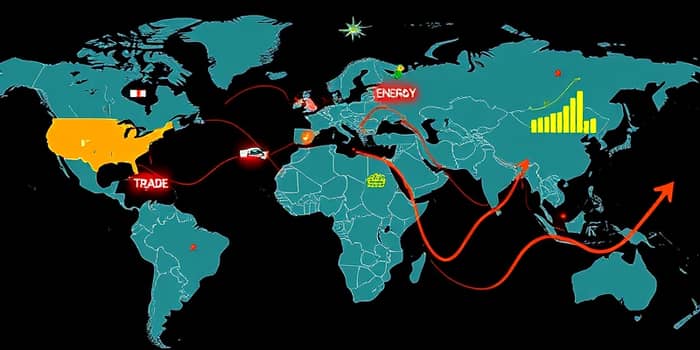
Geopolitical developments no longer play a background role in financial markets; they shape the very contours of risk and opportunity. From new tariffs to intensifying conflicts, geopolitical forces are driving short-term volatility spikes and sowing seeds of long-term economic fragmentation. Understanding these dynamics is essential for investors seeking to thrive in an uncertain world.
Market Volatility in a Fragmenting World
Global markets have historically weathered localized crises, rebounding as risk aversion subsided. Today, however, we face overlapping disruptions: renewed trade tensions, protracted wars, and a gradual dismantling of integrated supply chains. While episodic shocks tend to fade, chronic fragmentation poses a deeper challenge—potentially entrenching persistent inflationary pressures and redefining sector leadership.
Several transmission channels amplify geopolitical shocks:
- Financial: Risk aversion spikes credit spreads and fuels capital outflows from emerging markets.
- Real Economy: Trade and supply chain disruptions lead to commodity surges in energy and food.
- Policy Response: Central banks delay easing to combat sticky inflation, prolonging higher-for-longer rates.
Investors must distinguish between transient headline risks and structural shifts ushering in a new era of persistent market dislocations.
Recent Geopolitical Shocks and Market Reactions
From early 2025 through mid-2026, a series of high-profile events unsettled markets across asset classes. Each shock spurred an immediate sell-off, followed by a partial recovery as headlines faded—yet the cumulative effect has been profound.
US Tariffs and Trade Wars Renewed reciprocal tariffs announced on April 2, 2026, targeted Chinese goods, autos, metals, and critical minerals. A 90-day pause from April 9 excluded China but failed to quell uncertainty. Equities slumped, the VIX spiked, and 10-year Treasury yields jumped by 50 basis points to above 4.5% within a week.
Ukraine War The ongoing invasion since 2022 disrupted energy flows, sent food and fuel prices higher, and triggered global equity drawdowns—especially in Europe. Yet once supply channels adapted and uncertainty eased, markets rebounded, underscoring resilience in the face of prolonged conflict.
Middle East/Iran Conflicts Late February through early April 2026 saw escalations between the US, Israel, and Iran, threatening oil and LNG shipping through the Strait of Hormuz. The S&P 500 fell nearly 9% from its January peak, MSCI EAFE and EM indices dropped 8–12%, and gasoline prices hit $3.96 per gallon, a 33% rise.
US-China Tensions Threats of Treasury bond sales by China and blacklisting of key tech firms have stoked fears of financial decoupling. The risk of bifurcated technology standards and capital controls could reshape global investment flows for years.
Economic Impacts and Data Trends
These geopolitical shocks have weighed on growth forecasts and prolonged inflation above central bankers’ comfort levels. In 2025, global growth forecasts were revised downward, while sticky energy and food prices compelled the Federal Reserve and others to maintain higher rates longer than anticipated.
Key metrics as of mid-April 2026:
Meanwhile, the US dollar has strengthened to levels unseen since the mid-1980s, only to face medium-term headwinds as tariffs and slower growth erode rate differentials.
Strategies for Navigating Uncertainty
Investors must adapt to a marketplace where geopolitical risk sits alongside earnings and monetary policy as a core driver of returns. Practical steps include:
- Diversify across regions and asset classes to mitigate localized shocks.
- Allocate to safe-haven assets such as gold, US Treasuries, and cash during acute stress.
- Rotate into sectors benefiting from higher defense and energy spending.
- Maintain flexibility: use tactical overlays and options to hedge tail risks.
Long-term investors should focus on underlying fundamentals while respecting the potential for persistent supply chain bottlenecks and policy fragmentation.
Building Resilience for the Road Ahead
History shows markets ultimately gravitate back to corporate earnings and growth trajectories after geopolitical headlines recede. However, the frequency and interconnectedness of modern conflicts introduce a new paradigm—one where policy fragmentation and protectionism may linger.
To build resilience:
- Monitor pivot points: oil prices, trade policies, defense budgets, flashpoints in Asia and the Middle East.
- Embrace technological innovation and sustainability trends that transcend borders.
- Align portfolios with companies demonstrating robust supply chain management and geopolitical agility.
By integrating geopolitical analysis into investment processes and maintaining a disciplined, long-term perspective, investors can transform disruption into opportunity. Volatility need not be feared; it can be harnessed to enter positions during dips, lock in gains, and reposition for the next phase of global economic evolution.
Geopolitics will continue to drive market tides. Those who study its currents and prepare accordingly will navigate this era of uncertainty with confidence—and may ultimately emerge stronger on the other side.
References
- https://www.spglobal.com/en/research-insights/market-insights/geopolitical-risk/impact-of-geopolitics-global-economic-outlook
- https://www.ainvest.com/news/geopolitical-events-impact-stock-market-sentiment-equity-moves-2604/
- https://www.usbank.com/investing/financial-perspectives/market-news/russia-ukraine-global-market.html
- https://www.investing.com/analysis/how-geopolitics-is-reshaping-the-us-stock-market-and-what-comes-next-200677279
- https://hudsonpoint.com/learning-center/how-geopolitical-turmoil-can-influence-global-stock-markets
- https://www.axialfg.com/axial-updates/how-geopolitical-events-are-affecting-markets-right-now/
- https://privatebank.jpmorgan.com/nam/en/insights/markets-and-investing/how-do-geopolitical-shocks-impact-markets
- https://www.youtube.com/watch?v=WZZ8zA3TgS8
- https://www.suerf.org/publications/suerf-policy-notes-and-briefs/geopolitical-risks-and-their-impact-on-global-macro-financial-stability-literature-and-measurements/
- https://www.spglobal.com/en/research-insights/market-insights/geopolitical-risk
- https://www.schwab.com/learn/story/geopolitical-risk-is-evolving-what-you-should-know
- https://www.blackrock.com/corporate/insights/blackrock-investment-institute/interactive-charts/geopolitical-risk-dashboard
- https://www.weforum.org/stories/2024/12/global-trade-geopolitics-uncertainty-economic-policy/
- https://www.economicsobservatory.com/how-are-geopolitical-risks-affecting-the-world-economy
- https://www.stonex.com/en/business/financial-glossary/geopolitical-risk/