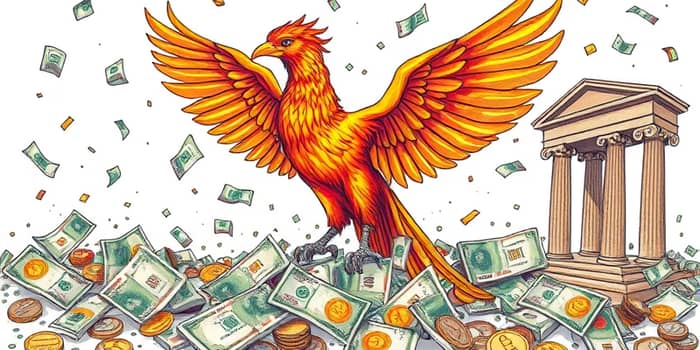
Throughout history, financial upheavals have reshaped societies, toppled empires, and forever altered the course of economies. By studying these setbacks, we uncover recurrent themes across financial crises and equip ourselves to face future uncertainties with wisdom and courage.
Understanding Historical Crises
From the credit collapse of 1772, sparked by Alexander Fordyce’s flight from London debts, to the Great Depression’s devastating unemployment surge, history offers a tapestry of cautionary tales. Each event—be it the stagflation of the 1973 OPEC Oil Shock, the currency turmoil of the 1997 Asian Financial Crisis, or the 2007–08 Global Financial Crisis—reveals how speculation, policy missteps, and overly easy credit expansion can combine to produce sweeping ruin.
Early banking collapses, like the 14th-century Peruzzi and Bardi failures, and 18th-century bubbles in South Sea and Bengal, remind us that human behavior—greed, fear, and herd mentality—remains unchanged. By tracing these patterns, we learn not only the structural flaws in markets but also the psychological pitfalls that prey on investors, institutions, and regulators alike.
Early Warnings: Recurring Patterns
While each crisis has unique triggers, several common factors repeatedly emerge. Recognizing these red flags can empower individuals and leaders to take preemptive action and mitigate widespread harm.
- Rapid asset price inflation: Unsustainable booms in housing, commodities, or equities.
- Excessive leverage and concentrated bets: Hidden risks magnified by debt and opaque derivatives.
- Inadequate liquidity buffers: Swift withdrawals or margin calls that drain cash reserves.
- Fraud and accounting manipulations: Off-balance-sheet entities concealing true exposure.
- Policy misalignment or external shocks: Fixed exchange pegs, abrupt rate hikes, or geopolitical disruptions.
By monitoring economic indicators—credit growth, debt-to-GDP ratios, and labor productivity trends—stakeholders can anticipate stress points. Transparent data sharing and independent audits serve as early defense lines, highlighting vulnerabilities before they escalate into full-blown crises.
Iconic Case Studies and Their Lessons
Examining landmark failures provides vivid illustrations of how specific mistakes amplify into systemic risk. Three of the largest U.S. bank collapses highlight critical takeaways:
Washington Mutual’s downfall illustrated how lax underwriting and excessive financial speculation and leverage can trigger mass withdrawals. Silicon Valley Bank’s liquidity crunch underscored the perils of mismatched asset-liability management, while First Republic revealed how loss of depositor confidence can spread contagion faster than regulators can respond.
Beyond banking, corporate giants like Enron and Lehman Brothers showcase different failure modes. Enron’s fraudulent accounting and shell entities taught the world the necessity of clear and transparent financial reporting. Lehman’s use of Repo 105 transactions to mask debt emphasized that even well-regulated firms can collapse under complex concealment schemes.
Preventive Strategies for Individuals and Institutions
Armed with historical insights, we can adopt practical measures to strengthen financial resilience at every level. Whether you are a retail investor, a corporate executive, or a policy-maker, these guiding principles offer tangible protection against future shocks.
- Maintain diversified portfolios: Spread risk across asset classes and geographies.
- Preserve adequate cash reserves: Build contingency funds for unexpected downturns.
- Conduct rigorous due diligence: Verify counterparties and confirm asset values.
- Emphasize transparent governance: Enforce independent audits and conflict-of-interest controls.
- Advocate proactive regulation: Support stress testing and prudent capital requirements.
For institutions, integrating robust risk-management frameworks and adopting stress-test scenarios based on worst-case historical events can illuminate hidden vulnerabilities. Individuals should resist the temptation of “get-rich-quick” schemes by evaluating underlying fundamentals rather than following speculative fads.
Building a Resilient Financial Future
While history cannot be rewritten, its lessons form a blueprint for sustainable growth and stability. Regulatory reforms, such as post-2008 Dodd-Frank requirements and central bank liquidity facilities, demonstrate the power of coordinated policy responses. However, stability also demands vigilance—ongoing assessments of emerging technologies, shadow banking, and digital assets to ensure new innovations do not sow the seeds of the next collapse.
On a personal level, cultivating a mindset of continuous learning and skepticism can transform setbacks into opportunities. By embracing unwavering focus on liquidity reserves and championing innovative regulatory frameworks and supervision, we honor the sacrifices of those who endured past failures and pave the way for a brighter, more secure financial landscape.
Conclusion: Embracing Lessons, Inspiring Progress
Financial crises are inevitable in a dynamic global economy, but their devastation need not be endless. Through diligent study, transparent practices, and collaborative reform, we can harness hindsight to safeguard prosperity for future generations. Let each lesson from history fuel our collective resolve, transforming fear into foresight and vulnerability into resilience.
References
- https://www.bankrate.com/banking/largest-bank-failures/
- https://www.britannica.com/story/5-of-the-worlds-most-devastating-financial-crises
- https://en.wikipedia.org/wiki/List_of_economic_crises
- https://drexel.edu/~/media/Files/coas2/politics/Tapia_FromTheOilCrisisToTheGreatRecession%20-%20FiveCrisesOfTheWorldEconomy%202014.ashx?la=en
- https://www.fregolaw.com/5-famous-business-bankruptcies/
- https://www.federalreservehistory.org/essays/great-recession-and-its-aftermath
- https://resonanzcapital.com/insights/the-27-biggest-odd-failures-that-shook-finance
- https://www.johnsonfinancialgroup.com/about-us/newsroom/a-brief-history-of-economic-crisis-crashes-and-recoveries/
- https://www.quicken.com/blog/12-epic-financial-failures/
- https://www.youtube.com/watch?v=KHLY6SyLvgQ
- https://www.fdic.gov/bank-failures/failed-bank-list
- https://www.frbsf.org/research-and-insights/publications/economic-letter/2020/05/historical-patterns-around-financial-crises/
- https://opportunityinstitute.org/blog/post/the-4-or-5-worst-market-failures-in-human-history/
- https://www.worldfinance.com/special-reports/the-top-ten-great-financial-crises