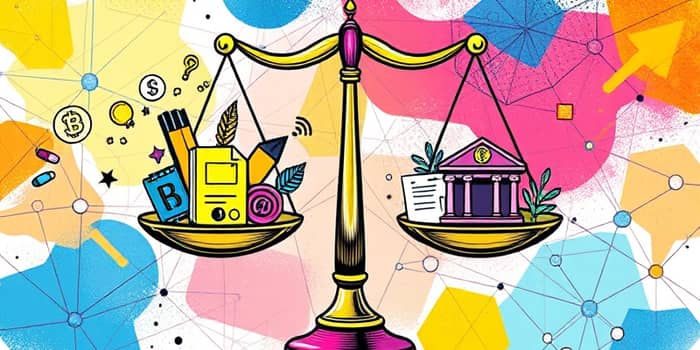
In today’s rapidly evolving financial landscape, institutions face a critical challenge: how to innovate boldly without jeopardizing stability. The tension between pursuing breakthrough technologies and managing inherent risks has never been more intense. This article unpacks the core of the Innovator’s Dilemma, explores the financial tools that can stifle creativity, and offers actionable strategies to achieve a harmonious balance.
Understanding the Innovator’s Dilemma in Finance
Clayton M. Christensen’s seminal work on the Innovator’s Dilemma reveals why established firms excel at sustaining improvements but falter when faced with disruptive change. In finance, banks and credit unions tirelessly refine products for high-value customers, all the while overlooking emerging fintech solutions like DeFi, peer-to-peer lending, and Open Banking.
These disruptive innovations often start by serving underbanked populations or niche markets. At first, they seem inferior to incumbent offerings, but they improve fast, eventually capturing mainstream share. Legacy institutions, anchored by legacy metrics and customer priorities, can be caught flat-footed, losing ground to scrappy newcomers.
The Role of Financial Tools as Innovation Killers
Traditional financial analysis methods—NPV, ROI, payback period—favor predictable returns and penalize uncertainty. As a result, promising projects with long-term payoff can be dismissed before they ever get traction. This creates what some call a “conspiracy against successful innovation.”
Three key culprits drive this phenomenon:
- Excessive focus on profitable customers, ignoring underbanked segments.
- New products misaligned with real customer jobs, leading to poor adoption.
- Rigid reliance on NPV and ROI thresholds, undervaluing uncertain opportunities.
By scrutinizing every prospective initiative through a lens calibrated for known markets, firms inadvertently kill nascent ideas that require time and patience to mature.
Navigating Risks in New Product Launches
Introducing any innovative financial product demands a comprehensive risk assessment. Teams must anticipate and mitigate challenges early to avoid costly course corrections down the road. Product maturity ranges from “bleeding edge,” with high uncertainty and shifting customer demand, to “leading edge,” which employs proven technologies but poses significant implementation hurdles.
Evaluating risk requires a multidimensional approach. Below is a snapshot of how key risk types manifest in finance and strategies to control them:
Beyond these categories, teams must remain agile to regulatory shifts, especially in emerging markets where legal frameworks are still forming. Building early relationships with regulators and participating in sandbox environments can provide valuable insights and reduce friction.
Fintech Evolution: Promise vs. Reality
The fintech revolution promised dramatic disruption. Instead, many developments have been sustaining in nature—digital account opening, AI-driven personalization, mobile wallets. While these enhancements improve customer convenience, they rarely overthrow core banking models.
P2P lending platforms and DeFi projects garnered headlines but have yet to achieve widespread adoption for everyday consumers. Incumbents leveraged their deep customer relationships and regulatory know-how to integrate or outcompete niche players. Few traditional banks have failed, underscoring the resilience of entrenched institutions.
Parallel corporate stories reinforce this lesson. Companies like Agfa-Gevaert and Volkswagen faced costly workforce reductions after lagging in digital transitions. These examples illuminate the perils of complacency when innovation is treated as optional rather than essential.
Financial and Strategic Considerations for New Initiatives
Assessing a new product’s viability goes far beyond surface metrics. Teams must:
- Challenge assumptions and document rigorously to enable back-testing.
- Conduct scenario analyses to capture best- and worst-case outcomes.
- Quantify nonfinancial benefits such as increased customer trust.
- Translate technical performance into tangible financial impacts.
Even minor cost or adoption variances can make or break a project. As such, transparent documentation and frequent recalibration are indispensable. Recognizing that new products can alter capital ratios and operational budgets is key to securing stakeholder buy-in.
Strategies to Foster Sustainable Innovation
To conquer the Innovator’s Dilemma, institutions can employ several tactics that balance risk with growth:
- Establish internal disruption units—small, autonomous teams with startup mindsets.
- Forge fintech partnerships to combine agility with scale.
- Implement a clear planning framework:
- Avoid double down on failures—pivot decisively when metrics underperform.
Leading banks like BBVA, Nordea, and KBC demonstrate how embracing agility and personalization can outmaneuver pure neobanks. Their success underscores the importance of combining deep domain expertise with a willingness to embrace continuous transformation and agility.
Conclusion: Turning Tension into Opportunity
Innovation in finance need not be a zero-sum game between growth and stability. By recognizing the pitfalls of conventional financial tools, rigorously managing risks, and adopting a strategic framework, institutions can cultivate breakthroughs that endure.
Ultimately, balancing innovation with prudent governance transforms the Innovator’s Dilemma from a looming threat into a source of competitive advantage. Success belongs to those who can simultaneously uphold regulatory standards, reassure stakeholders, and focus product-market fit and customer needs—all while charting a path toward a more dynamic financial future.
References
- https://hbr.org/2008/01/innovation-killers-how-financial-tools-destroy-your-capacity-to-do-new-things
- https://www.communitybankingconnections.org/articles/2013/q1/considerations-when-introducing-a-new-product
- https://www.finextra.com/blogposting/27867/the-innovators-dilemma-in-financial-services-a-decade-of-fintechs-evolution
- https://www.abacademies.org/articles/challenges-and-opportunities-in-the-adoption-of-fintech-in-emerging-markets-17612.html
- https://www.hbs.edu/faculty/Pages/item.aspx?num=46
- https://corporate.visa.com/en/products/visa-direct/blog/four-challenges-facing-fintech-businesses-around-the-world.html
- https://www.finsync.com/blog/the-innovators-dilemma-and-how-small-businesses-win/
- https://www.uptech.team/blog/fintech-challenges
- https://en.wikipedia.org/wiki/The_Innovator's_Dilemma
- https://www.alkami.com/blog/top-4-challenges-of-marketing-for-financial-institutions-and-how-to-solve-them/
- https://cheresearch.org/uncategorized/the-innovators-dilemma/
- https://legal.thomsonreuters.com/en/insights/articles/how-to-take-on-the-challenges-of-fintech
- https://blog.array.com/overcoming-the-top-8-challenges-for-financial-services