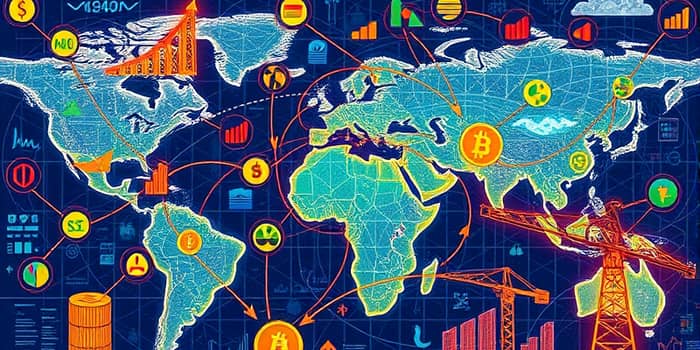
In an increasingly complex world, threats to our finances can arrive not only through direct market swings but also via hidden channels. These secondary or ancillary exposures often go unnoticed until they trigger cascading losses. Recognizing and preparing for less evident but still consequential hazards has never been more critical.
Direct vs. Indirect Financial Risks
Direct financial risks are familiar: a drop in asset value or physical damage to property you own causes an immediate loss. By contrast, indirect risks arise through chains of events or relationships beyond your immediate control.
When a factory is flooded, the repair bill is a direct risk. However, the cost of halted deliveries, workforce displacement, and strained supplier networks represent intermediate connections rather than occurring directly. These ripple effects can inflict equal or greater harm.
Major Categories of Indirect Financial Risk
Indirect risks span many domains. Understanding each category helps organizations build resilience where direct measures fall short.
Each category carries unique challenges. Market-related risks often manifest when fluctuating interest rates undermine stock valuations without a direct sale. Physical climate risks extend beyond asset damage to infrastructure and services your business depends on.
In banking, indirect lending through dealers creates credit and compliance exposures far removed from the institution’s direct oversight. Cryptocurrency platforms face indirect sanctions risk when funds flow through multiple wallets before reaching illicit destinations.
The Cascading Effect of Indirect Risks
Indirect risks rarely travel alone. A climate event in one region can disrupt transportation, which then delays inventory, forcing production cuts elsewhere. This chain can escalate into revenue shortfalls, strained cash flows, and increased borrowing costs.
Because these effects can occur with time lags and geographic separation, organizations may struggle to trace back to the original cause. Recognizing that a single hazard can spawn multiplicative rather than additive risk is the first step toward a robust defense.
Detection and Assessment Challenges
Measuring direct exposures is straightforward: asset value, replacement cost, or price volatility. Indirect exposures, however, require mapping complex networks of relationships. Counting transaction “hops” or setting arbitrary thresholds often misses context.
Effective assessment demands scenario analysis, stress testing, and continuous data monitoring. Financial institutions and corporate risk teams must identify key nodes in their supply chains, vendor arrangements, and digital networks to spot vulnerabilities early.
Risk Management and Mitigation Strategies
Mitigating indirect risks involves a combination of planning, policies, and monitoring. Institutions should develop strategies that encompass the full life cycle of potential exposures:
- Establish comprehensive vendor and counterparty risk frameworks
- Define clear underwriting and monitoring policies for indirect programs
- Implement real-time data analytics and scenario-based stress tests
- Maintain an exit strategy for exposures that exceed risk appetite
- Regularly review and update legal agreements and contingencies
By embedding these practices into governance structures, organizations can reduce the chance that a hidden threat will blindside leadership or regulators.
Regulatory and Institutional Expectations
Regulators now expect comprehensive coverage of both direct and indirect risks. Banking supervisors scrutinize indirect lending programs, looking for robust dealer management and consumer compliance. Crypto regulators require that platforms flag suspicious exposure chains, even if no direct transaction occurred.
Institutions that fail to detect or address significant indirect exposures face sanctions, license revocations, and reputational damage. Building transparent risk frameworks and documenting assessment processes are essential to demonstrate due diligence.
Case Studies: Lessons from the Field
Consider a regional credit union that rapidly expanded its indirect auto loan portfolio without sufficient controls. Within months, payment deferments soared, dealer repurchase demands spiked, and the union’s balance sheet became untenable. Regulators intervened, and leadership was replaced.
Another example comes from a multinational manufacturer whose critical supplier was hit by flooding. Lacking alternative sources or contingency stock, production ceased for weeks. The company ultimately lost market share and incurred large penalty payments to customers.
These real-world scenarios illustrate how overlooking indirect exposures can escalate into existential threats. Organizations must learn from precedents and proactively shore up vulnerabilities before they compound.
Conclusion: Embracing the Unseen Hand
Indirect financial risks may be invisible, but their consequences are tangible and often severe. By adopting a holistic approach—mapping relationships, stress testing scenarios, and embedding strong governance—leaders can illuminate hidden threats and transform uncertainty into competitive advantage.
Embrace the unseen hand that shapes financial outcomes. Equip your team with the tools and insights to identify indirect risks early, respond decisively, and safeguard your organization’s future success.
References
- https://www.binance.com/en/academy/articles/financial-risk-explained
- https://www.sustainalytics.com/esg-research/resource/investors-esg-blog/capturing-the-direct-and-indirect-risks-of-physical-climate-change-in-investment-portfolios
- https://ncua.gov/regulation-supervision/letters-credit-unions-other-guidance/indirect-lending-and-appropriate-due-diligence
- https://pressbooks.bccampus.ca/financialimpactclimatechange/chapter/direct-and-indirect-risks/
- https://www.trmlabs.com/glossary/indirect-risk
- https://unionrisk.us/insights/direct-and-indirect-risk/
- https://www.minneapolisfed.org/article/2014/indirect-lending
- https://www.kbibenefits.com/indirect-loss-vs-direct-loss-what-are-the-differences
- https://dashboard.myriadproject.eu/steps/characterization-of-indirect-risk/
- https://www.epa.gov/climateleadership/climate-risks-and-opportunities-defined
- https://www.scribd.com/document/978099855/SOP-Report